
Main Ports & Airports
VIETNAM’S LARGEST CONTAINER PORTS
One of the strengths of the Vietnamese economy is its extensive network of seaports stretching from North to South. So, which is the largest container port in Vietnam?
Haiphong Port
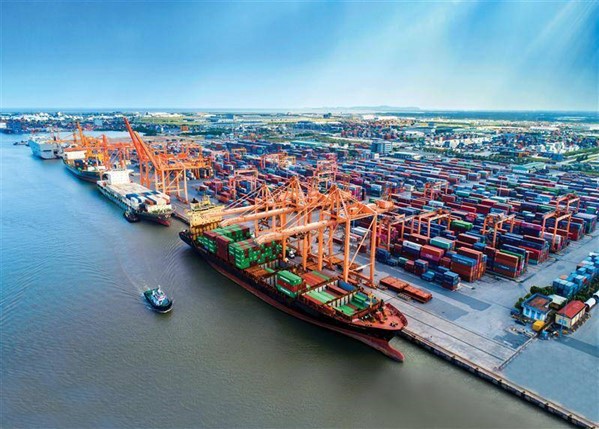
Built by the French in 1874, Hai Phong Port is now the most modern container port in Northern Vietnam. With its advanced infrastructure, state-of-the-art equipment, 200 surveillance cameras, and a comprehensive information and personnel management system, Hai Phong Port is a strategically advantageous and secure location suitable for international trade and transportation.
Currently, Hai Phong Port comprises 5 branches. The port area has 21 berths with a total length of 3,567m and a designed depth in front of the berths ranging from -7.5m to -9.4m. The total container yard area at the Chua Ve and Tan Vu port branches is 712,110m2, and 3,300m2 for the CFS warehouse at Chua Ve port.
As the seaport with the highest cargo volume in Northern Vietnam, Hai Phong Port has the capacity to handle approximately 10 million tons per year, with the Hoang Dieu Port branch accounting for nearly 60% of the cargo handled. Simultaneously, the largest vessel size it can accommodate is 40,000 DWT at the Lan Ha transshipment area, while the smallest is 700 DWT at the Bach Dang buoy berth.
Aiming for stable and sustainable development, Hai Phong Port is implementing the Dinh Vu Port investment project with 5 berths and increasing the vessel capacity to 55,000 DWT, and in the future to 100,000 DWT at Lach Huyen, along with investments in information technology infrastructure.
Saigon Port (Ho Chi Minh Port)
Saigon Port is the main port of Southern Vietnam, playing a key role in connecting maritime transport between the Southeast region and the Mekong Delta.
Since its initial opening in 1860 during the French colonial period, the port of Saigon has become an international port. Its total area is 500,000 m², comprising five port zones (Passenger Port, Nha Rong Khanh Hoi Port, Tan Thuan Port, Tan Thuan 2 Port, and Phu My Steel Port) with 3,000 m of wharves, 30 mooring buoys, and 280,000 m² of warehouse space.
With a focus on sustainable development and as Vietnam’s main maritime gateway, alongside setting itself the goal of improving service standards, Saigon Port will develop and operate a deep-water port and become a national strategic port in Southern Vietnam.
Da Nang Port
Finally, Da Nang Port also belongs to the group of general cargo ports, serving as a national hub. Da Nang Port has three terminal areas: Tien Sa – Son Tra, Lien Chieu, and Tho Quang. Tien Sa – Son Tra is the main terminal area with a total yard area of 178,603 m2 and a warehouse area of 14,285 m2.
Aiming to be the most modern seaport in Central Vietnam, Da Nang Port is currently implementing the second phase of the Tien Sa Port expansion project by 2018, increasing the vessel capacity to 50,000 DWT and 3000 TEU container ships, while also establishing a transshipment warehouse area of 30 to 50 hectares during the 2015-2020 period.
Quy Nhon Port
Located in the heart of Quy Nhon city, Binh Dinh province, and possessing favorable natural conditions and geographical location, Quy Nhon port is recognized as the leading port in the Central region, capable of receiving ships with a tonnage of 30,000 DWT to 50,000 DWT.
The port has a total land area of 306,568 m2; the total warehouse area is 30,732 m2, including a CFS warehouse of 1,971 m2; and the yard area is 201,000 m2, with a container yard of 48,000 m2.
In the future, an investment of approximately 180 billion VND is planned for Quy Nhon Port to upgrade the shipping channel, enabling it to safely and conveniently accommodate ships of up to 50,000 tons. Simultaneously, after coming under the investment management of the Vietnam Maritime Corporation, Quy Nhon Port is poised to become an international port in the South Central region, boosting opportunities for the development of Vietnam’s maritime transport industry.
Quang Ninh Port
Quang Ninh Port is a deep-water seaport located in the key economic zone of Northern Vietnam. According to the Ministry of Transport’s plan, Quang Ninh Port ranks second among the most important seaports in Northern Vietnam, after Hai Phong, which holds the central position.
The port has a total land area of 154,700 m2; the total warehouse area is 5,400 m2 and the container yard is up to 49,000 m2.
With favorable natural and climatic conditions and existing infrastructure, Quang Ninh port is constantly developing and improving its technical and technological systems while ensuring close security to enhance the quality of its services.
According to the government’s plan, a port area in My Han Bay will become part of Dung Quat Port in the future.